Spreadsheets power global finance, and learning how to build a percentage calculator in Excel allows you to analyze budgets, calculate taxes, and assess profit margins effortlessly.
The Fundamental Rule of Excel Percentages
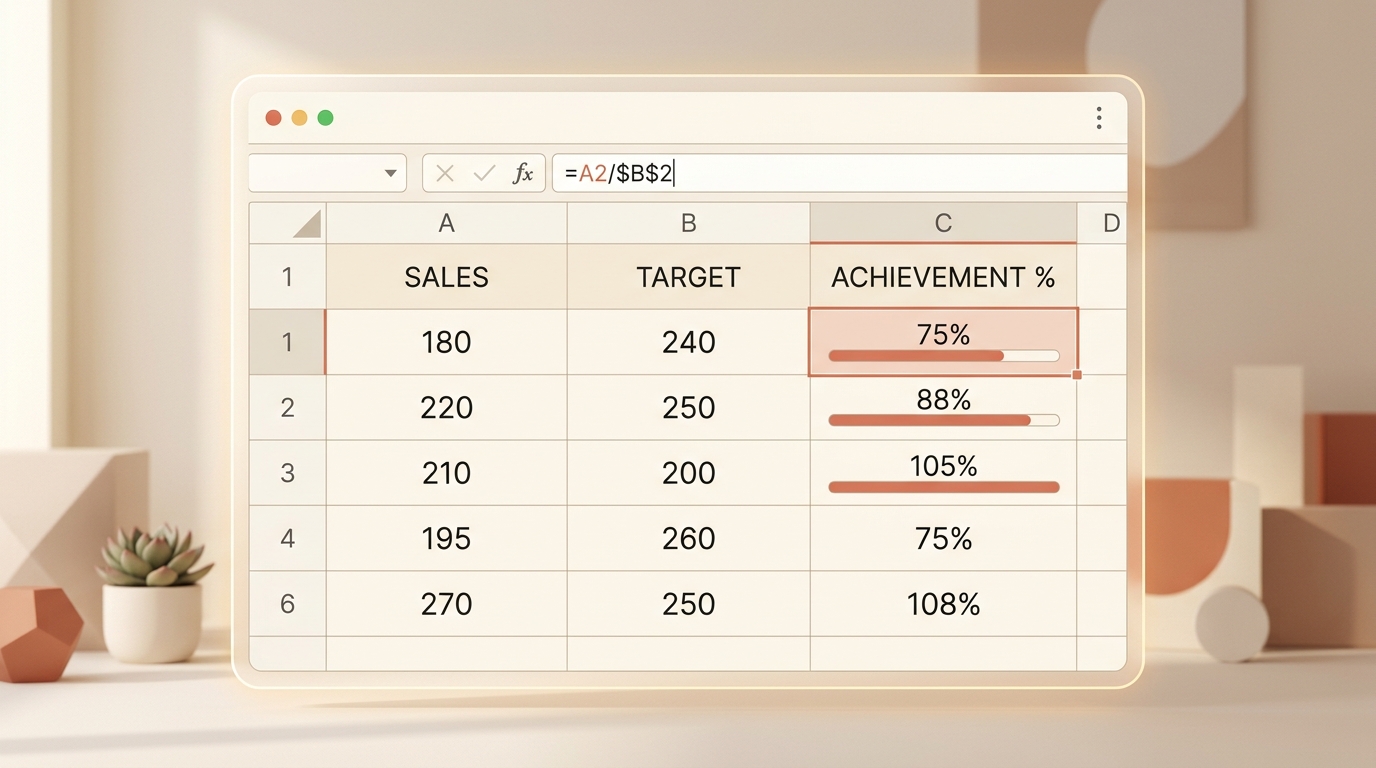
Excel stores percentages as underlying decimal fractions between 0 and 1. When you enter 25%, Excel stores 0.25 internally. When you apply the Percentage format, Excel handles visual multiplication for you.
Formula 1: Calculate Percentage of a Total
Suppose column A contains departmental expenses and cell A10 contains the total sum (=SUM(A2:A9)). To find each department’s share:
Enter in cell B2: =A2/$A$10. The dollar signs freeze cell A10 so you can drag the formula down.
If you need quick verification outside Excel, test your figures on our Ratio Tool.
Formula 2: Percentage Increase or Decrease
To compute growth between last year’s sales (A2) and this year’s sales (B2):
Enter: =(B2 - A2) / A2, then format as Percentage. If sales increased from 500 to 650, Excel will cleanly display 30.0%.
Formula 3: Applying a Percentage to an Amount
To calculate a 7.5% sales tax on an order of $120 in cell A2: =A2 * 0.075 (or =A2 * 7.5%). To calculate total price with tax: =A2 * (1 + 0.075).
Validate your calculations with our online Percentage Calculator.