Whether preparing budget spreadsheets, calculating medication dosages, or verifying invoice totals, using a robust percentage calculator percent calculator system ensures precision and prevents costly calculation oversights.
Why Dual Verification Matters in Math
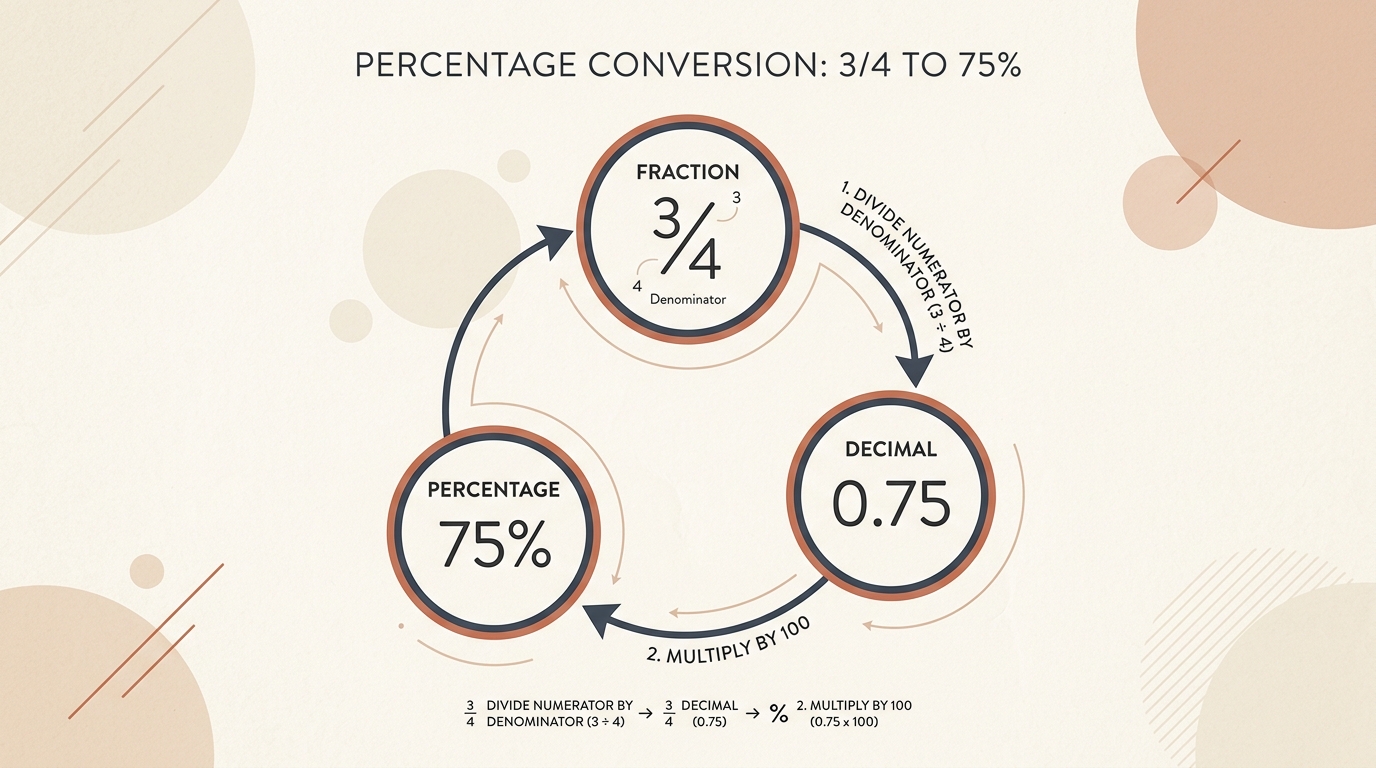
In mathematics, every percentage problem connects three variables: the Base Amount ($B$), the Rate ($R%$), and the Portion ($P$):
Double-check your numbers instantly with our free tools: Main Percentage Calculator and Ratio Verification Tool.
The Triangle of Percentage Variables
Every percentage arithmetic problem involves three interconnected quantitative components:
Given any two variables, the third can be isolated algebraically with absolute certainty:
- Solving for Part:
P = (R ÷ 100) × W(e.g., What is 15% of 200? → 30) - Solving for Rate:
R = (P ÷ W) × 100(e.g., 30 is what percent of 200? → 15%) - Solving for Whole:
W = P ÷ (R ÷ 100)(e.g., 30 is 15% of what number? → 200)
| Unknown Variable | Given Data | Algebraic Formula | Step-by-Step Calculation |
|---|---|---|---|
| Find the Part | Rate = 25%, Whole = 360 | P = 0.25 × 360 | 0.25 × 360 = 90 |
| Find the Rate (%) | Part = 45, Whole = 180 | R = (45 ÷ 180) × 100 | 0.25 × 100 = 25% |
| Find the Whole | Part = 75, Rate = 30% | W = 75 ÷ 0.30 | 75 ÷ 0.30 = 250 |
Avoiding Floating-Point Quirks
When performing chained percentage calculations, never round intermediate numbers. Keep full decimal precision in memory until the final result is ready for display, rounding only the final answer to 2 decimal places for financial reporting.
Double-check your values with our responsive online percentage tool.